A takeover agreed on Sunday was dead by Friday. easyJet’s board spent this week discovering what happens when a distressed European asset with irreplaceable slot portfolios is put in play: not one bidder, but two, and a price that has climbed 79% above where the stock sat in May. The bidding war for Britain’s second-largest carrier is the clearest signal yet that private capital has stopped viewing European short-haul as a value trap and started viewing it as an entry point. Less panic, more facts.
This week — 6 to 12 July 2026 — also brought the first operational flights under the FAA’s eVTOL Integration Pilot Program, Emirates confirming A380 capacity into Delhi, Frontier moving decisively into the vacuum left by Spirit’s collapse, and Copa quietly breaking the commercial model that has governed Starlink’s airline rollout since inception. Below, the developments that matter, and the ones worth watching into Farnborough.
Airlines
Emirates Commits A380 Capacity to Delhi as India Bilaterals Stay Frozen
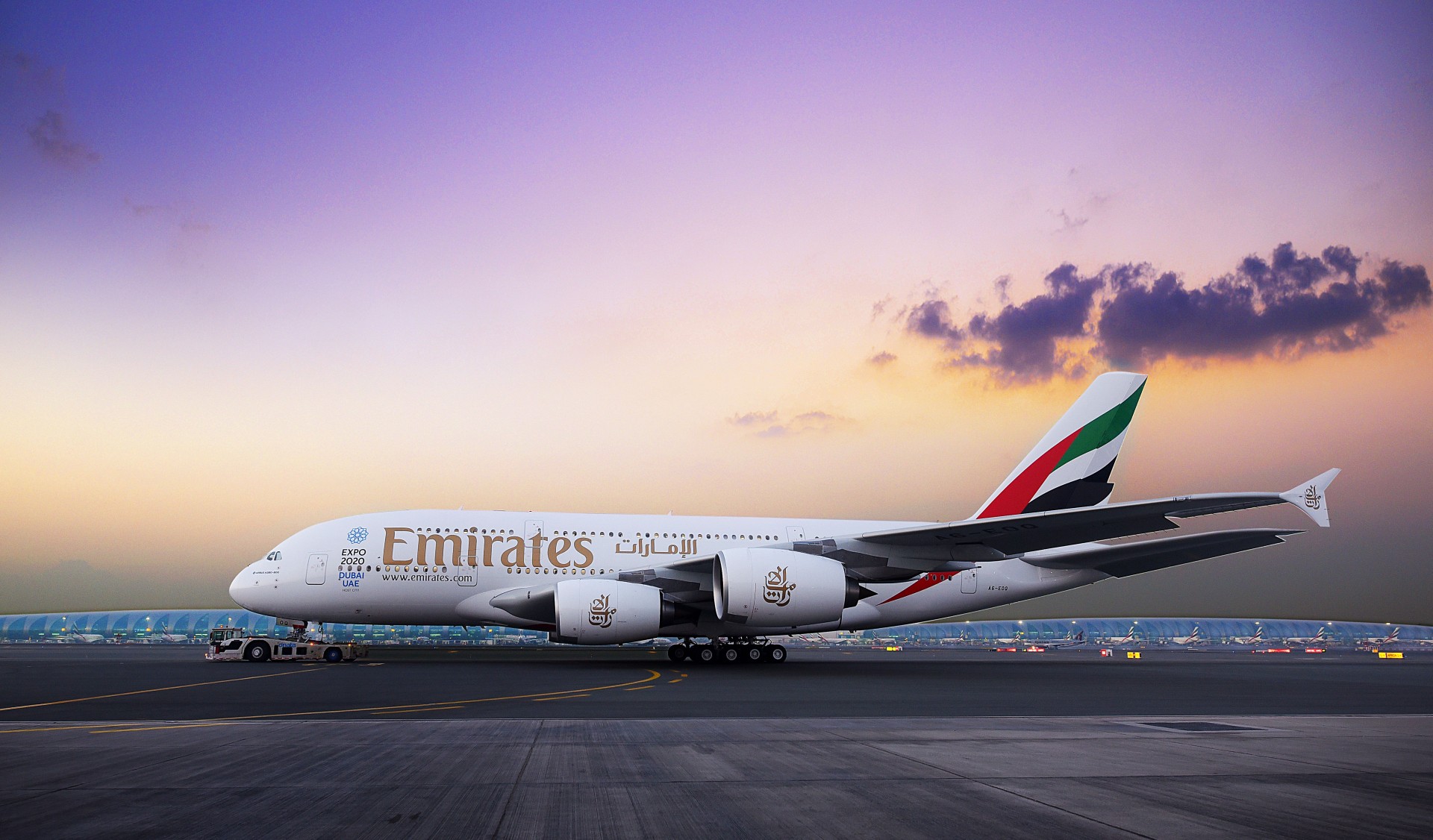
Image: Emirates Airbus A380-800 in current livery | Emirates
Emirates announced on 9 July that it will deploy the A380 on the Dubai–Delhi route from 25 October, operating flights EK512/513 in a four-class configuration. Delhi becomes the carrier’s third A380 destination in India after Mumbai and Bengaluru. The airline’s three remaining daily Delhi frequencies will continue on retrofitted four-class Boeing 777s, meaning Premium Economy will be available across all four daily rotations. Emirates simultaneously confirmed A350 deployment on one daily Dubai–Kolkata frequency from the same date, with the remaining five weekly services staying on retrofitted 777s — bringing Premium Economy to all twelve weekly Kolkata flights. By end-October, six Indian gateways will have the product: Delhi, Mumbai, Ahmedabad, Bengaluru, Kolkata and Kochi.
The strategic logic is unambiguous and has little to do with cabin marketing. India–UAE bilateral entitlements have been effectively capped for more than a decade, leaving Gulf carriers unable to add frequencies into the subcontinent’s largest markets. Where frequency is constrained, gauge is the only remaining lever. Substituting a 777 for an A380 on a single Delhi rotation lifts weekly seat count materially without consuming a single additional entitlement, and it does so with a disproportionate share of that increment landing in premium cabins. Adnan Kazim, Emirates’ Deputy President and Chief Commercial Officer, framed the move around demand and partnership; the commercial reality is that Emirates is extracting maximum yield per frozen slot. For competitors — IndiGo’s widebody build-out chief among them — this is a reminder that Emirates can still escalate on the world’s most valuable constrained corridor without regulatory permission.
Frontier Absorbs Spirit’s Network, Targeting a 3–5% RASM Uplift
Frontier Airlines (Nasdaq: ULCC) began service on eight former Spirit Airlines routes on 5 and 6 July, its most visible move yet into the space vacated by Spirit’s operational shutdown in early May. The routes are Boston–Orlando, Dallas/Fort Worth–New Orleans, Detroit–Fort Lauderdale, Detroit–Philadelphia, Detroit–Las Vegas, Las Vegas–Kansas City, Orlando–Memphis and Orlando–Richmond, with introductory one-way fares from $39. Josh Flyr, Frontier’s VP of network and operations design, positioned the launch around preserving low-fare access. The eight routes are a subset of a far larger summer redeployment: Frontier’s schedule now carries 38 more routes than the same month last year, of which 33 are domestic.
The number that matters to investors is not the fare. Frontier management expects Spirit’s exit to lift revenue per available seat mile by 3 to 5 percentage points — an unusually clean read on what a competitor’s disappearance is worth in a market where ULCC capacity has been structurally oversupplied for years. Frontier operates 164 Airbus A320-family aircraft, the largest A320neo fleet in the United States, with roughly 200 more on order, so it has the metal to consolidate. The open question is discipline: the same route economics that killed Spirit have not changed, and several of these city pairs are being restored at low frequency, which offers thin operational buffer and limited connecting recovery. Frontier is simultaneously moving upmarket with UpFront Plus and a First Class cabin from 2026 — a hedge that concedes the pure unbundled model was not, on its own, survivable.
Wizz Air Bases Eighth Aircraft at Sofia as Bulgarian Capacity Rises 61%
Wizz Air based an eighth Airbus A321neo at Vasil Levski Sofia Airport this week, simultaneously launching services to Budapest and Rhodes with lead-in fares from €14.99. The addition takes Wizz’s based fleet across Bulgaria to eleven aircraft, all A321neos following a complete fleet renewal, and the carrier now operates 71 routes from Bulgaria to 20 countries. Summer 2026 capacity from Sofia reaches 2.1 million seats, a 61% increase year on year, delivered across 144 weekly departures. The airline puts the employment impact at 40 direct and roughly 350 indirect jobs.
Wizz’s annual market share at Sofia has reached 30.6%, rising to around 33% for the summer peak — a level of single-carrier concentration that reshapes the airport’s negotiating position and its exposure. SOF Connect, the concessionaire, gets the traffic growth it needs to underwrite its terminal investment case; it also gets a dominant counterparty whose capacity can be redeployed to Bucharest, Belgrade or Tirana on short notice. The broader pattern is familiar across Central and Eastern Europe: Wizz is buying share with A321neo unit costs in markets where the incumbent flag carrier is either weak or absent, and secondary airports are pricing that growth aggressively. The commercial risk sits with the airports, not the airline.
Copa Launches Starlink — and Charges For It
Copa Airlines confirmed on 6 July that it has become the first Latin American carrier to fly with Starlink connectivity, with its first equipped aircraft — a Boeing 737 MAX 9, registration HP-9901CMP — entering service on 4 July. Phased installation across the all-737 fleet is targeted for completion in the first quarter of 2027. Copa previously had no inflight connectivity on any aircraft, making it the largest carrier in the region without a Wi-Fi product; the leap from nothing to low-Earth-orbit broadband is substantial.
The commercially significant detail is the access model. Complimentary Starlink is limited to Business Class passengers, ConnectMiles PreferMember Gold, Platinum and Presidential members, and existing Starlink Residential or Roam subscribers. Everyone else pays through an onboard portal. SpaceX’s stated position since entering the IFC market has been that passengers should not pay at the point of use, and every prior airline deployment has followed that line. Copa’s structure is the first public break from it, and it materially changes the business case other carriers will run: if Starlink can be monetised rather than merely absorbed as a cost of competing, the payback calculation for a fleet-wide retrofit shifts. Watch whether SpaceX permits this to become a template or treats it as a one-off concession to a carrier it wanted in the region.
Etihad Signs fastjet Zimbabwe MoU Ahead of 2027 Harare Launch
Etihad Airways and fastjet Zimbabwe signed a Memorandum of Understanding in Harare on 7 July establishing an interline partnership, a codeshare agreement and a future frequent flyer tie-up. Sales open on 24 August 2026. Under the arrangement, Etihad passengers will connect onward on fastjet to Bulawayo, Victoria Falls and Johannesburg on a single ticket. fastjet becomes the 32nd airline partner of Etihad Guest.
Read in isolation, this is a minor interline. Read against Etihad’s network plan, it is preparatory infrastructure: the carrier launches direct Abu Dhabi–Harare service on 24 March 2027, and a point-to-point Gulf–Harare route cannot be filled on origin-destination traffic alone. The fastjet agreement builds the domestic and regional feed that makes the route viable before a single seat goes on sale, extending Etihad’s reach beyond the capital into Victoria Falls tourism traffic and the Johannesburg corridor. It is a textbook example of sequencing partnership ahead of metal — and a reminder that Etihad’s Africa build-out is being executed with more commercial rigour than its 2010s expansion. Arik De, Etihad’s Chief Revenue and Commercial Officer, described Africa as central to the carrier’s growth; the structure of this deal suggests that is not merely rhetorical.
Mergers, Acquisitions & Finance
Apollo Trumps Castlelake with £7.15 Per Share for easyJet
Image: easyJet Airbus A320neo in current livery | easyJet
The sequence matters. On 5 July, easyJet and Castlelake jointly announced the board was “minded to recommend” a £6.90 per share cash proposal valuing the airline at up to £5.5 billion — a 73% premium to the 29 May close, and Castlelake’s fifth attempt after four rejections at 560p, 600p, 625p and 650p. On 8 July, Apollo Global Management tabled £7.15 per share in cash. On 10 July, easyJet’s board announced an agreement in principle with Apollo, valuing the carrier at approximately £5.7 billion, and withdrew its support for Castlelake. Shares rose roughly 13% on the day but remain below the offer price. Castlelake must announce a firm intention to bid under Rule 2.7 by 3 August; Apollo’s deadline is 7 August.
Two structural issues will determine whether either bid completes. The first is ownership and control: EU and UK rules require carriers operating on European AOCs to be majority-owned and effectively controlled by EU or UK nationals. Castlelake addressed this by capping itself at 49% of the bidding vehicle, with 51% held by EU-qualifying co-investors including Brookfield, former easyJet COO Peter Bellew and Mark Breen — a structure easyJet itself had earlier called “opaque.” Apollo must solve the same problem, and has not yet disclosed how. The second is the underlying business. easyJet reported a pre-tax loss of £552 million in the first half of FY26, widening from £394 million, on revenue of £3.95 billion, with management pointing to elevated fuel costs and reduced forward visibility following the Iran conflict. Bernstein’s read is that Apollo’s price requires a cost restructuring and earnings inflection well beyond current forecasts. The persistent discount at which the shares trade is the market’s own verdict on completion risk.
What is not in doubt is why easyJet is being fought over. The carrier operates around 355 aircraft across more than 1,200 routes in 38 European countries, and its slot portfolios at London Gatwick, Paris and Geneva are close to irreplaceable. Apollo — which has previously held positions in Sun Country, Aeroméxico, Atlas Air and Virgin Atlantic — has said it backs the existing strategy of up-gauging the fleet, building ancillary and loyalty revenue, and scaling easyJet Holidays into a differentiated earnings stream. Apollo is offering a stub equity alternative allowing shareholders to roll into the acquisition vehicle with voting rights, and Barclays has issued a highly-confident letter on the debt. Sir Stelios Haji-Ioannou’s family retains 15.3%. Whether Castlelake returns before 3 August is now the central question in European aviation finance.
DAE and Neuberger Launch Mustang Aerospace, Targeting $6 Billion
Dubai Aerospace Enterprise and Neuberger Specialty Finance agreed this week to establish Mustang Aerospace, a co-investment platform targeting approximately $6 billion of aircraft investments over the medium term. The vehicle allows DAE to deploy origination and asset management capability against third-party capital rather than balance sheet, while Neuberger Berman’s asset-based finance arm — which manages more than $5 billion across over 50 portfolio companies and has deployed more than $16 billion since 2018 — gains access to aviation assets through an operator with an established servicing platform.
The structure is now the dominant model in the sector, and for good reason. OEM delivery constraints have kept current-generation narrowbody values firm and lease rates rising, while the largest lessors are increasingly capital-constrained following consolidation. Splitting origination from balance sheet lets managed platforms scale without the equity drag, and it gives institutional allocators an aviation exposure with a servicer attached. Expect more of these announcements: the same week brought Aviation Capital Group’s $1.48 billion facility and a steady stream of secondary trades, all pointing to the same conclusion — capital is abundant, aircraft are not, and the intermediation layer is where the returns are being captured.
Aviation Capital Group Closes $1.48 Billion Unsecured Term Loan
Aviation Capital Group secured a $1.48 billion unsecured term loan facility through its wholly owned subsidiary ACG Aircraft Financing Ireland DAC, guaranteed by ACG. The syndicate comprises 33 lenders across multiple jurisdictions, with the facility maturing in July 2031 and drawable until January 2027. No amounts have been drawn to date. Arrangers include DBS Bank, The Bank of East Asia, Cathay United Bank, China Construction Bank, CTBC Bank, ICBC and OCBC. Proceeds are earmarked for capital expenditure, refinancing of existing debt and general corporate purposes.
The composition of the syndicate is the story. A 33-lender unsecured facility, heavily weighted to Asian banks, arranged for an undrawn five-year tenor tells you that lessor credit is being priced as investment-grade infrastructure rather than cyclical transport risk. Unsecured capacity at this scale — with no security package over the aircraft — is a function of ACG’s ownership and rating, but it also reflects an asset class that has now delivered through a pandemic, a rate cycle and a supply shock without materially impairing lenders. For airlines negotiating sale-leasebacks, the read-through is unhelpful: lessors’ cost of capital is falling while aircraft scarcity persists, which is precisely the combination that pushes lease rates up.
Airport Developments
FL Technics Opens $25 Million Paint Facility at Denpasar
Image: FL Technics Indonesia MRO complex, Denpasar | FL Technics
FL Technics Indonesia has opened a dedicated aircraft painting facility at its Denpasar, Bali base, a reported $25 million investment. The first customer was Skyway Airlines, the Philippine cargo carrier, whose third Boeing 737-400F was repainted and ferried to Clark International Airport for an inaugural ceremony on 3 July. The paint booth sits within a 17,000 m² hangar complex developed with PT Angkasa Pura, offering six narrowbody positions and employing more than 500 local technicians. The facility holds FAA Part-145 approval alongside certification from Australia’s CASA, covering the A320 family and Boeing 737 Classic, NG and MAX.
Chairman Martynas Grigas noted that several further painting projects have already been secured and that demand from Southeast Asian operators has exceeded expectations. That is the point: paint capacity is one of the region’s genuine bottlenecks, and operators have historically ferried aircraft to Singapore, China or the Gulf for a task that adds no value in transit. Bringing it to Denpasar removes days of positioning from every livery change, redelivery and lease transition in a region where narrowbody fleets are growing faster than the MRO base supporting them. Bali’s position on the Australia–Asia corridor makes it structurally well-placed. The broader constraint remains engines rather than airframes — Bain’s assessment is that engine MRO demand peaks in 2026 and stays tight through the decade — but airframe and surface capacity is where operators can actually add supply quickly, and FL Technics is doing so.
Airports Authority of India Opens Jodhpur Terminal as UDAN Enters Next Phase
The Airports Authority of India inaugurated a new terminal at Jodhpur Airport this week. Built at a cost of ₹4.8 billion (approximately $50.3 million), the 23,342 m² facility is designed for 1,500 peak-hour passengers and two million annually, with 20 check-in counters, six jet bridges, and an apron capable of handling eleven Airbus A321s plus one ATR 72. The opening coincided with the launch of the next phase of India’s UDAN regional connectivity scheme, which envisages roughly ₹290 billion of investment over the coming decade, the development of 100 additional aerodromes, and continued support for regional air services.
The apron specification is the tell. Eleven A321 stands at a Tier-2 Rajasthan airport is not regional-turboprop infrastructure; it is a bet that IndiGo and Akasa will up-gauge into secondary Indian cities with narrowbodies as soon as the demand supports it. UDAN’s first decade was criticised — often fairly — for subsidising routes that collapsed the moment viability gap funding expired. The next phase is being built around durable infrastructure rather than route subsidy, which is a more defensible use of public capital and considerably more interesting to lessors and operators modelling Indian domestic growth. For anyone assessing where India’s next tranche of narrowbody deliveries actually gets deployed, the answer is increasingly visible in the concrete.
Bucharest Awards Design Contract for 176,000 m² Terminal
Leviatan Design has been awarded the design contract for the first phase of the expansion of Bucharest’s Henri Coandă International Airport. The contract, valued at approximately $23 million, covers a new 176,000 m² passenger terminal, part of an expansion programme sized against projected traffic of around 30 million passengers.
Henri Coandă has been operating well beyond comfortable capacity for several years, and Romania has been among the fastest-growing markets in Europe on the back of Wizz Air’s and Ryanair’s expansion — growth the existing terminal was never designed to absorb. A 176,000 m² building implies a step change rather than an incremental extension, and the design award is the point at which the programme becomes real enough to model. The relevant question for carriers is what happens to charges: Bucharest’s low-cost proposition has depended on cheap infrastructure, and a terminal of this scale has to be paid for. Airlines that built Romanian networks on current cost assumptions should be running the sensitivity now.
Sun Group and Changi Airports International Broaden Vietnam Partnership
Sun Group and Changi Airports International expanded their strategic partnership this week, extending an existing collaboration at Phu Quoc International Airport into a broader framework covering airport master planning, design optimisation, construction advisory, pre-opening preparation, and operations and maintenance. The agreement also encompasses the development of aviation services across Sun Group’s wider airport portfolio, which includes Van Don International Airport, Phu Quoc, and Phan Thiet Civil Airport, currently under development.
Vietnam is one of the few markets where private airport development at scale is actually happening, and Sun Group has been the principal vehicle for it. What Changi brings is not capital but the operating discipline that Vietnamese privately-developed airports have conspicuously lacked — commercial revenue optimisation, pre-opening readiness and the master planning rigour that determines whether a terminal is still fit for purpose a decade after opening. For Changi Airports International, the arrangement extends an advisory footprint across a portfolio rather than a single asset, which is a materially better commercial position. Expect this template — regional developer, Singaporean operating expertise — to be replicated across Southeast Asia.
Industry Innovations & Services
BETA Flies First eIPP Missions, Carrying Manufactured Organs
BETA Technologies (NYSE: BETA) completed the first operational flights under the US DOT and FAA’s eVTOL Integration Pilot Program on 10 July, flying its all-electric ALIA CX300 across roughly 275 nautical miles between four airports — Virginia Tech/Montgomery Executive (KBCB), Charlottesville-Albemarle (KCHO), Frederick Municipal (KFDK) and Martin State (KMTN) — carrying manufactured organs developed by United Therapeutics (Nasdaq: UTHR). The missions were flown under the Multistate Collaborative eIPP National Integration Complex, an 18-state consortium led by PennDOT. BETA was selected for seven of the FAA’s eight eIPP launch programmes, more than any other electric aircraft developer.
The significance is regulatory, not technical. eIPP is the mechanism by which the FAA generates operational data on pre-certification electric aircraft in the national airspace system — a three-year programme spanning 26 states — and BETA has now defined what the first mission profile looks like. That gives it a data advantage and a seat at the table as the operating rules are written. The financials remain sobering: BETA posted a first-quarter 2026 net loss of $122.3 million on revenue of $10.1 million, against a backlog of roughly $3.9 billion across 991 aircraft including 289 firm orders, and closed 2025 with $1.71 billion in cash. It has flown over 160,000 nautical miles and deployed charging infrastructure at 123 sites. Type certification for the ALIA 250 eVTOL is targeted for 2028. Cargo first, passengers later, is not a technology constraint — it is deliberate regulatory sequencing, and it is working.
LODD Autonomous Enters Formal Certification for Hili Cargo VTOL
Abu Dhabi-based LODD Autonomous has begun the formal certification programme for its Hili uncrewed hybrid-powered VTOL cargo aircraft with the UAE’s General Civil Aviation Authority. Hili is designed to carry payloads of up to 250 kg over ranges of up to 700 km (378 nm), making it among the longest-range cargo UAV programmes in the region. Certification is being supervised by Abu Dhabi’s Smart and Autonomous Systems Council, with the GCAA as certifying authority, supported by the Integrated Transport Centre and the Abu Dhabi Investment Office through its SAVI cluster. LODD has an agreement with Ambitious Air Mobility Group covering the potential sale of up to 50 aircraft — 25 for Europe, 25 for the UAE and Middle East — and an MoU exploring integration into DHL Express’s network.
The certification basis is the interesting part. LODD says the GCAA is taking a risk-based approach built on internationally recognised principles and referencing relevant EASA requirements rather than starting from a blank sheet. That matters because the UAE is positioning itself as a jurisdiction where novel aircraft can achieve certification faster than in Europe or the United States without the resulting approval being commercially worthless elsewhere. Archer is pursuing a restricted type certificate for Midnight in Abu Dhabi on comparable logic. The strategic bet is that early UAE approvals create operating history and safety data that subsequently accelerate FAA and EASA processes — a bet worth watching closely, because if it works it changes where advanced air mobility gets certified first.
Hyundai and KAI Set 2034 Target for Dual-Use eVTOL
Hyundai Motor Group and Korea Aerospace Industries are targeting 2034 for commercialisation of a jointly developed dual-use eVTOL covering urban air mobility, cargo transport, emergency response and military resupply and reconnaissance. The partners intend to redesign the airframe from scratch, finalise a joint design by 2027, and apply for type certification with both US and South Korean authorities in 2028. Hyundai contributes electrified powertrain technology and mass-production capability; KAI brings airframe development, certification and industrial production, alongside a control and communications architecture based on low-Earth-orbit satellites.
This is a consolidation, not an acceleration. Hyundai’s US subsidiary Supernal cut roughly 296 staff — around 80% of its workforce — and paused flight testing before the KAI agreement was signed in May, having previously targeted a 2028 launch for the S-A2. A 2034 date is a six-year slip dressed as a national programme. Read honestly, it is the clearest admission yet from a well-capitalised automotive entrant that eVTOL certification economics are harder than the sector’s 2021 projections allowed, and that survival requires an aerospace partner with a defence balance sheet behind it. The dual-use framing is not incidental: military demand is what will fund the development, and civil UAM is what might eventually monetise it. Other automotive-backed programmes should be assessed against the same standard.
Key Watch Items
A220-500: The Decision Airbus Cannot Keep Deferring
Image: Airbus A220-300 in flight | Airbus
The A220 marks ten years in service this week — the type entered revenue service with SWISS on a Zurich–Paris rotation on 15 July 2016. The programme has delivered its 500th aircraft, is flown by 25 operators across five continents, has passed 1,000 firm orders and has carried more than 240 million passengers. It has also never achieved sustained profitability since Airbus took control of the former Bombardier C Series in 2018. Against that backdrop, Airbus is weighing a simple stretch — the A220-500 — adding roughly five fuselage frames and 20 to 25 seats over the A220-300 to reach approximately 180, retaining the existing wing and Pratt & Whitney GTF engines. Guillaume Chevasson, who heads the A220 programme, has confirmed studies have accelerated and that a five-abreast cabin would be retained; Airbus wants to understand the range penalty before committing.
The conundrum is well understood and unresolved. A 180-seat A220 lands directly in A320neo territory, and Airbus’s own analysis is that it may divert demand from a more profitable product rather than attract new customers — which is why Reuters reported in June that Airbus had tempered launch expectations after airline and lessor soundings. Against that, AirAsia’s Tony Fernandes, having placed the largest A220 order in history at 150 aircraft, has said publicly that he would buy 150 more of a 185-seat variant. Farnborough runs 20–24 July. A launch announcement was widely penciled in for the show; the more likely outcome now is continued study. Either way, the question of whether Airbus is willing to cannibalise the A320neo to fix A220 unit economics will be answered, one way or another, in the next fortnight.
FAA Supersonic NPRM: Comment Period Runs to 17 August
The FAA’s notice of proposed rulemaking, “Enabling Supersonic Overland Flight” (Docket FAA-2026-6935), was published in the Federal Register on 2 July, with comments due by 17 August. Directed by Executive Order 14304, the proposal would repeal the 1973 speed-based prohibition in 14 CFR 91.817 and replace it with a performance standard: civil supersonic overland flight would be permitted where sonic boom overpressure at the surface does not exceed 0.11 pounds per square foot, subject to a demonstration accepted by the Administrator and compliance with any conditions imposed. A second NPRM covering landing and takeoff noise standards is expected later this year, with the FAA targeting finalisation of both by mid-2027.
The mechanism the rule effectively legitimises is Mach cutoff, where altitude, speed and atmospheric conditions combine to refract the boom back into the atmosphere before it reaches the ground. NASA’s X-59 reached Mach 1.1 at 43,400 feet on 5 June, and Boom Supersonic has demonstrated the technique on XB-1. For operators, the relevant point is that a performance-based threshold rather than a blanket ban makes an overland supersonic route network conditionally modellable for the first time since Concorde — conditional on atmospheric conditions, which vary by season and geography and will materially affect schedule reliability. The comment period is where airlines, airports and communities will shape what “conditions and limitations” actually means. Anyone with a view should be filing by 17 August.
JetZero Moves into the FAA’s Transport Certification Office
JetZero has begun fuselage assembly on its full-scale Jet1 blended wing body demonstrator at Northrop Grumman’s Scaled Composites facility in Mojave, with wing skin fabrication commencing and a curing oven to be constructed around the wing because no existing oven accommodates the span. First flight is targeted for late 2027. Separately — and more consequentially — the FAA has transferred the programme out of its emerging technologies division (AIR-600) into the Integrated Certificate Management Office (AIR-500), the division responsible for Part 25 certification of large transport aircraft. CEO Tom O’Leary notes that the only other companies in that group are Boeing, GE Aerospace and Pratt & Whitney. JetZero plans to file for type certification later this year.
The demonstrator is partly funded by a $235 million US Air Force programme awarded in 2023, powered by the same Pratt & Whitney engines as the Boeing 757, and JetZero raised $175 million in a Series B led by B Capital with participation from United Airlines Ventures, Northrop Grumman and RTX Ventures. The production Z4 targets the 200–270 seat middle of the market — the segment Boeing has repeatedly declined to address. Scepticism is warranted and well-articulated: Leeham’s Bjorn Fehrm argues the promised fuel savings remain unproven and the configuration suits military missions better than passenger operations, and Richard Aboulafia has been clear that proving efficiency is only the first hurdle before funding a certification and production programme. But the regulatory reclassification is not a press release — it is the FAA signalling the design is mature enough for the standard process. Watch the type certification filing.
Boston Warwick Weekly Aviation Insights — Verified, source-checked analysis of the developments shaping airline, airport and investor strategy — delivered every week to senior aviation leadership. Subscribe to Aviation Insights
Sources
- easyJet plc — Investor announcements, Castlelake and Apollo proposals, 5–10 July 2026
- CNBC — easyJet weighs rival Apollo takeover bid, 10 July 2026
- Reuters / RTÉ — Apollo trumps Castlelake with £5.7bn easyJet bid, 10 July 2026
- Emirates — A380 deployment on Dubai–Delhi from 25 October, 9 July 2026
- Frontier Airlines — Eight former Spirit routes launched, 5 July 2026
- Copa Airlines — Starlink inflight internet rollout, 6 July 2026
- Etihad Airways — fastjet Zimbabwe partnership, 7 July 2026
- Wizz Air — Sofia base expansion and new routes
- BETA Technologies — First operational eIPP flights, 10 July 2026
- Aviation Week — Airport Updates, week commencing 6 July 2026
- Aviation Week — Routes & Networks rolling updates, week commencing 6 July 2026
- Aviation Business News — FL Technics Indonesia opens Bali paint facility, 8 July 2026
- AviTrader — Aviation Capital Group $1.48bn facility, 10 July 2026
- AviTrader — DAE and Neuberger launch Mustang Aerospace, 6 July 2026
- Aviation Week — LODD launches Hili certification programme
- Runway Girl Network — Airbus A220-500 stretch studies, Mirabel briefing
- Federal Register — Enabling Supersonic Overland Flight, NPRM, 2 July 2026
- CompositesWorld — JetZero BWB demonstrator build and FAA certification milestone
This briefing is provided by Boston Warwick Ltd for information purposes only and does not constitute investment, legal or commercial advice. Figures and dates have been verified against primary sources at the time of publication. Boston Warwick Ltd accepts no liability for decisions taken on the basis of this material.